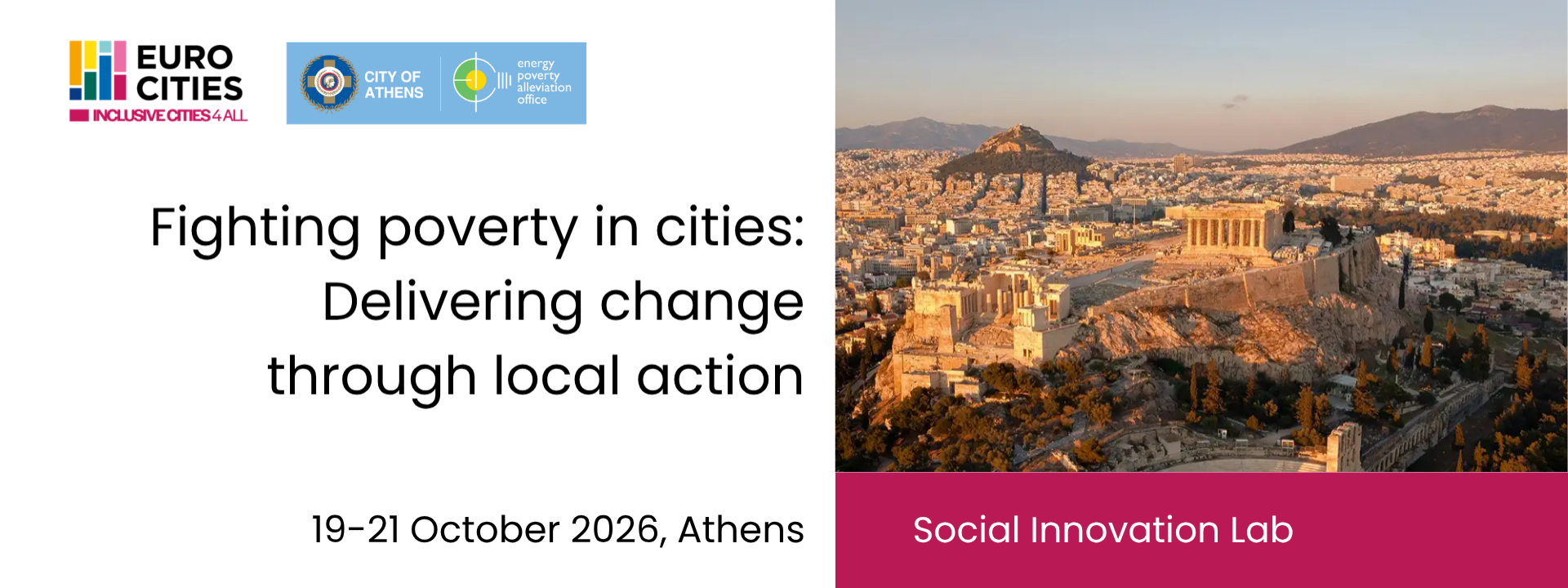
Fighting poverty in cities: Delivering change through local action
Background
From Monday 19 to Wednesday 21 October 2026, the City of Athens will host the sixth edition of the Eurocities Social Innovation Lab, which will focus on tackling urban poverty and strengthening cities' role in implementing the first-ever EU Anti-Poverty Strategy. The Lab will explore how cities can develop integrated, people-centred approaches to prevent and reduce poverty, ensuring that all residents can access their rights, essential services and opportunities to participate fully in society.
Poverty remains one of the most persistent and multifaceted challenges in the European Union. Around 93 million people are at risk of poverty or social exclusion, one in four of whom are children, while approximately one million people experience homelessness. Rising housing costs, increasing inequalities, and demographic change are placing growing pressure on vulnerable households, particularly in urban areas. Cities are often where poverty-related challenges are most visible and concentrated, but they are also uniquely positioned to deliver coordinated responses across housing, employment, education, health and social services.
The thematic priorities for this year’s Social Innovation Lab include:
- Tackling the housing crisis to combat poverty: Housing is increasingly at the centre of urban poverty, with rising costs, homelessness, poor housing conditions and energy poverty affecting residents' wellbeing and opportunities. Cities play a key role in developing integrated responses that combine homelessness prevention, social housing, support for vulnerable groups and housing resilience measures, ensuring that the just transition strengthens preparedness, protects those most at risk and reduces rather than deepens inequalities. (Green track)
- Ensuring equal access to essential services and social rights: Poverty is both a consequence and a driver of discrimination and social exclusion. People experiencing poverty often face unequal access to services and multiple, intersecting barriers linked to factors such as age, disability, gender, migration background, or ethnicity. Cities can help address these barriers by designing services that are accessible, inclusive, and responsive to people's needs, while ensuring that those most at risk can effectively access their rights and participate in decision-making. (Yellow track)
- Breaking intergenerational poverty and strengthening life-course inclusion, as poverty across different life stages can have cumulative and long-term impacts. Discussions will focus on coordinated action across education, employment, family support, income security and social inclusion to support pathways out of poverty. (Blue track)
Expected outcome
During the Social Innovation Lab, participants will exchange experiences, share practices and reflect on how to translate the EU Anti-Poverty Strategy into concrete action at local level. Through workshops, peer learning, site visits, NGO-led training, and exchange with other Eurocities Forums, participants will explore practical approaches to tackling poverty and social exclusion while contributing to Eurocities' work on strengthening the role of cities in implementing the EU anti-poverty strategy. The Lab will support participants in identifying and developing transferable solutions, including integrated policies, projects and governance approaches that address poverty in a cross-cutting and systemic way. Particular attention will be given to strengthening coordination across sectors, improving access to rights and services, and ensuring that local actions respond to the realities of people experiencing poverty. Eurocities will consolidate the key insights, practices and emerging approaches identified during the Lab, contributing to ongoing policy work and showcasing the crucial role of cities in delivering effective, place-based responses to poverty and social exclusion.
Funded by the European Union. Views and opinions expressed are however, those of the author(s) only and do not necessarily reflect those of the European Union. Neither the European Union nor the granting authority can be held responsible for them.